Showing posts with label Mystery Plant Monday. Show all posts

Monday, August 11, 2014

Too many things to do - Tuesday

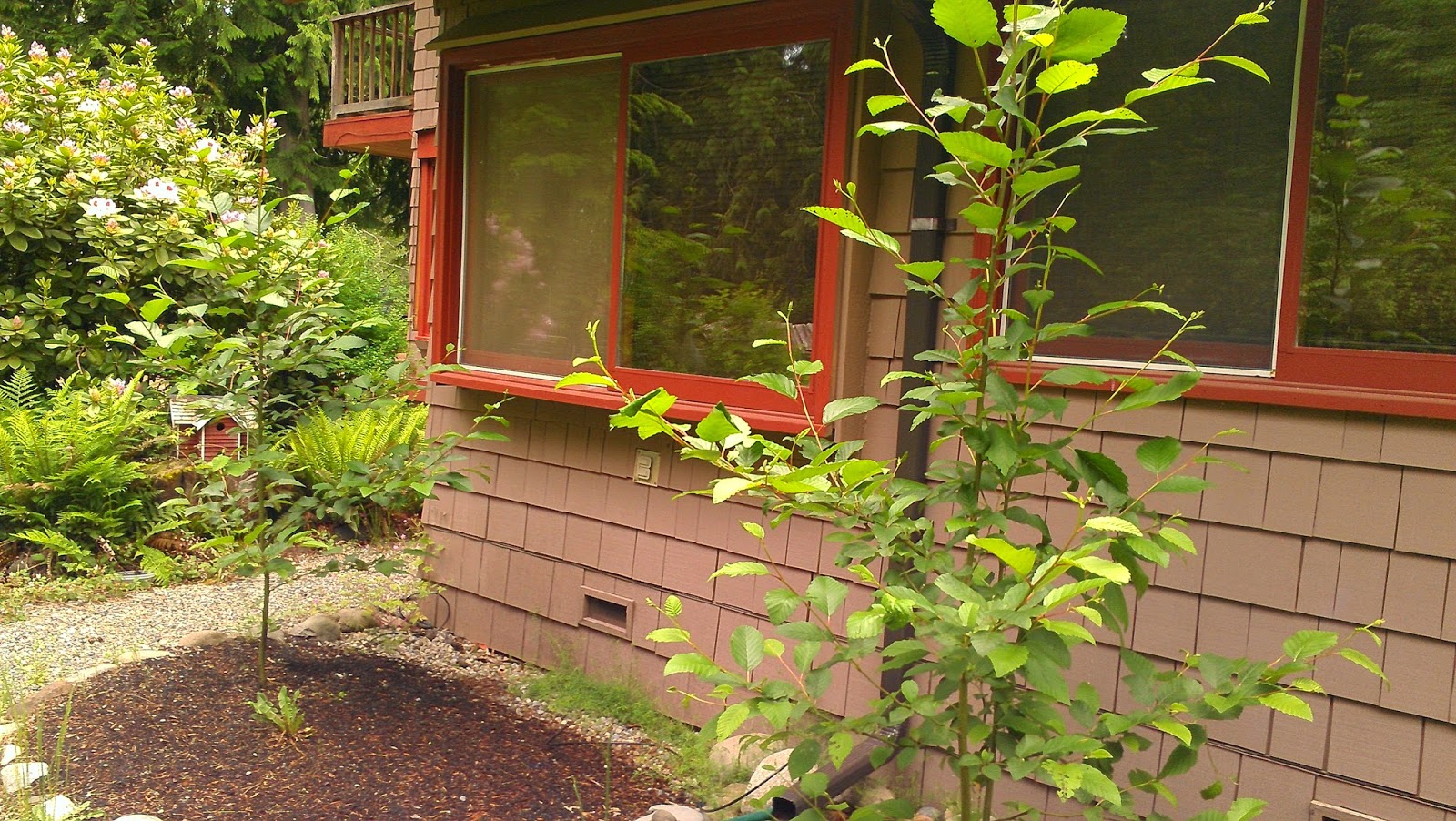
Ok, on a previous post I mentioned that this is NOT a hydrangea. It turns out that it is actually going to be a rather large deciduous tree. It was only about 2 1/2 feet tall when I first transplanted it.  I moved it to a sunny location in the back area of the house.  Bad move.


 These little puppies more than tripled in height in just one year. Yes, there are two. Both now clear the rooftop.  


Mystery Plant Monday


Today's post is an update on all things in the garden, although I do have a mystery or two to solve there as well. I can hardly believe that these are my hydrangeas. Love this plant! I have two varieties: the top is a vibrant violet purple, the bottom is a beautiful sky blue with creme centers. Nature is amazing for sure!


 Now for the rest of the garden tour . . .

Monday, August 4, 2014

Mystery Plant Monday!

THESE ARE NOT HYDRENGEAS


Last summer, mum pulled the dead plants out of these garden beds and relocated what she *thought* were hydrengeas from another garden. They were too small to identify, so she figured they'd keep here outside the downstairs office windows until they were big enough.

They tripled in size from last spring until now, haha!
So now they are the topic of mum's first mystery plant of the season. Mum clipped one of the shoots, making sure she had enough leaves for identification, then went hunting: 
leaves - Lobed vs Toothed
bark characteristics
Location etc

Mom used a tree identifier from the Arbor Day Foundation (http://www.arborday.org/trees/whattree/) Answered a series of questions and came out with two possibilities.

And the answer is . . . tree! Beech or Birch

They are still too young to tell- but either way, they'll get 60-80 ft tall!

DEFINITELY planning to relocate these suckers while we still can. The thought right now is maybe putting them by the dog kennel, to give it some eventual shade in the years to come. THAT  however would require digging a rather large whole in our Irish soil - rocks every two inches! We will need more than a shovel for that.

Monday, August 12, 2013

Mystery Plant Monday

My Mystery Plant of the week is a variegated vine with heart-shaped leaves. It's spreads low to the ground and grows is shade to dappled sunny locations around Our Haven.

It's called Aegopodium podagraria 'Variegatum' and goes by several names including Bishop's weed, Bishop's Wort, Bishop's Elder, Dog Elder, Dwarf Elder, Ground Elder, Goat's Foot, Goatweed, Farmer's Plague, Garden Plague, Ground Ash, Pot-Ash, Jack Jumpabout, English Masterwort, Pigweed, Eltroot, and a list of others.

No wonder people have a hard time identifying it!


 At first I thought it was pretty - very woodsy and it seemed to have little cream flowers. I thought, "What a neat ground cover."  HA! Little did I know.

As the season progressed, I started calling it "The Blob" because it spread quickly, swallowing everything in its path.  Now - it's a weed taking over the one flower bed I worked so hard to purifying and rejuvenating this spring. It went from a small section around the stump pictured above, to covering over 1/3 of the bed.  It is no longer "cute" but a weed and I want it out.

I have always been patient with weeds - after all, they are only plants growing where gardeners don't want them. However, according to my research on this darling, removing it will be a battle, and one I probably won't win.

One of my favorite comments was from This Garden is Illegal
DISCLAIMER: If you are ever offered this plant, run, do not walk, run quickly from the area before you are talked into taking some home.Bishop’s Weed is an avid gardener’s worst nightmare. Worse yet, it is sold in garden centers and big box stores with no warning label. Really, before they are allowed to take this stuff home, people should be required to sign iron-clad contracts that requires them never to pass this plant along.


Here are the good things about it:

  • It is a vigorous ground cover great for shady spots.
  • It's fast-growing and easy to care for (little care needed, really). 
  • It's deer resistant. 
  • It tolerates poor soil and conditions where little else will grow. It's like ivy in the respect that you can plant it and let it be and not have to do much. This is great for those wanting low maintenance. 
  • It's good for erosion control.


It grows best in zones 3-9 (so just about everywhere) in part sun to shade.
It starts at 12-24 inches tall and 12-48 inches wide (but doesn't stay there - just thing "the Blob"

It blooms early summer and the flowers rise above the foliage, seemingly floating in the air.

Bishop's Weed has been used medicinally for bee stings, burns, and the treatment of gout and psoriasis. That might convince me to grow it in a container out of harms way - but I don't want ti where it is now, no matter how woodsy it looks. It's about to choke my poor roses!

I'm not one for herbicides. I have been able to maintain pretty much all weed growth I need with a mixture of white vinegar, salt, and water.  This lovely however just laughs as the salty shower.

Next in my battle plan is conscientious pruning to keep it at bay until the spring. Because it's perennial, it will die back for the winter. I plan to cut it to the ground and cover it in black plastic tarp. Hopeful that will do the trick. If not, I pull out the big guns.

So, if you love your garden, and like your neighbors, this is not the plant for you. It's known to spread  most auspiciously because people pull it up and toss it in the woods or even compost where it takes root and takes off. So be mindful with it - if you must have it, contain it.


Monday, August 5, 2013

Mystery Plant Monday


Our mystery plant of the week. 


In a previous blog post I talked about my foibles with my bulb order (read more here). I got them planted but there were quite a few mystery plants due to the labels washing off in the soak. 

Now they look like this . . .
Some of them show no signs of sprouting. I'll overwinter them in the greenhouse and see what happens next year. If there's still nothing, then I'll compost them and try again. 
Others, like the Irises and Montauk Daisies seem to be doing just fine in spite of being appetizers for the chickens. Then there's this one (below). No idea what it is. At least I have my order form to start with and I know some of the things it's not. 

My method this time? Do an image search on my order list and see what I find. 
 And the winner is . . .  Asiatic Elodie Lily


Here's what I learned: 
Family: Liliaceae (lil-ee-AY-see-ee)
Genus: Lilium
Cultivar: Elodie

It will bloom with candy pink layers of petals. It is pollen-free and is often called a Kiss Lily. Blossoms can be anywhere between 3-6 inches. Tends to single bloom the first year and then double bloom in following years. 

Plant bulbs 4" deep about 8" apart.  It does well in pots or containers and will grow to 24-36" tall. It is hardy in zones: 3-8, hardy in 6-8, mulch in 3-6. 

It prefers a rather heavy soil with lots of humus and good drainage. It likes the soil to be mildly acidic (6.1-6.5) to neutral (6.6-7.5). It does well in full sun or partial shade and blooms mid to late summer. 

Propagate by dividing rhizomes, tubers, corms, or bulbs. Plant does not set seed, flowers are sterile (no pollen, remember)

Care: remove faded flowers and do not cut back stems until autumn. Bulbs shouldn't be lifted, only mulch if necessary. Will bloom annually for many years. 

Mystery solved. Now to add the details to my garden journal. 

I can't wait to see it in bloom. 


Monday, July 22, 2013

Mystery Plant Monday - two for one challenge, sort of.


I've been waiting to see what came out of this barrel since we moved in.  I inherited these lovelies from the previous owners when they left an overgrown wine barrel on the back deck.  I was curious to see what was inside so I let it overwinter and waited.  

My patience was rewarded with: 
Yellow Daylilies and ??? Buds that looked like they're from the mum family but leaves that looked like daisies. 


 They turned out to be, gorgeous Mountain Daisies. 


The poor barrel is SO VERY overgrown that I will be dividing it into multiple containers at the end of the season. 


OK, now for the REAL mystery plant:


I'm stumped on this one.
This is the largest one, but I've got shrubs like this growing out of five or six nursery logs all around the property.  


Bark


 This one (above) you can see some raspberry leaves protruding through, grrr. The birds and my chickens love the berries. 


I think it's a Mountain Ash, but I'm not sure.  Like the Ash, it has pinnate leaf structure and clumps of 30+ red berries. The piece that's throwing me off is that it's not growing from one main trunk, but a bunch of shoots.  

I give on this one for now - I'll observe through the season and fall and see what happens. 


Monday, July 15, 2013

Mystery Plant Monday

All images (C) Our Haven 2013

Here's another plant I've not seen before. It's in a rock garden of sorts. Seems to be similar to an ice plant. So that's where I begin my research. 

I think I have a better picture in my stash - here's one I took earlier this spring. 
I took this one in May


It reminds me of "ice plant" a bit - but it has electric blue tiny flowers and the leaves aren't as succulent like.  So that's out.

It also reminds me of "rosemary" but isn't woody like I've seen. It also hugs the rocks and only stands up a few inches. The leaf structure is very similar, but the flower structure doesn't match. 

Hmmm what else?? 

The flower color reminds me of lobelia but it's more cobalt and has much simpler  structure. Each flower head is at most 1/2 inch across.  The plant, I discovered by watching it this winter, is evergreen. Well it's someplace to start.

HA! Found it!!!! 

Lobelia gave me a clue. I put in a search for "electric blue flower" and halfway down the page, there it was. So my books loos out on this one too - I wonder if there's a "Name this Flower" ap somewhere - if there's not, there should be. 

the difference between Lobelia and Lithodora

Here are details on Lithodora from my research: 
Family: Boraginaceae
Genus: Lithodora (lith-oh-DOR-us)
Species diffusa (dy-FEW-sa)
Cultivar: Heavenly Blue?? or Grace Ward?? it's hard to tell.

You can read more at Dave's Garden - one of my first "go to's" when I want to learn about plant care. 

I learned that it's deer tolerant - apparently it's one of the last plants the critters will eat because they don't like the taste. 

It's great for rock gardens, butterfly gardens, woodland areas or as border plants. 
It is considered evergreen in USDA plant hardiness zone 6-8. 

It's a ground cover that forms a mass 6-12 inches tall and 36-48 inches wide. Flowers emerge in early spring and keep going through summer. (Mine have slowed in the warmer weather or because my chickens have been eating them)

It prefers well drained acidic to neutral soil and is drought tolerant.  I also likes loamy or sandy soil. I ready that it shouldn't be planted where there's too much clay. 

Something important for me as I want to propagate this puppy and spread it around or give it as gifts - it doesn't set seed. The flowers are sterile. Any plants that do come of see won't be true.  Propagation is from softwood cuttings (something I have to learn how to do - I'll add it to my wishlist. 

My mystery plant for this week - solved once again with the help "asking the right question" in a search engine.  

So internet research 2. Book research 0. 

Monday, July 1, 2013

Mystery Plant Monday - What is this tree?

My first post for Mystery Plant Monday, where I sleuth out the details of a puzzling plant or tree at Our Haven so that I know how to care for it or whether I want to continue with it, is for this lovely tree:  


See how nice and clean it is now? When we first moved in, this bed was a mess. Raspberry brambles had choked nearly everything.  This poor tree looked very sad, especially with no leaves (remember, we moved in in October). 

I'm not one for getting rid of the old and putting in new, but the thought crossed my mind after the umteenth hour of weeding and clearing just so the established plants could breathe.  It looks like once upon a time there was a very large fir tree (the trunk is still lying across the bed, now covered with other plants). I don't know how long the ferns will last in the abundance of sun the area now gets, but we'll see.  Back to the tree. . . 

After some judicious pruning, and removal of the brambles that were choking it, I gave it some tree vities and waited.  I am much better at recognizing trees in bloom, and with only the trunk and branches to clue me in, I had no idea what this was. 

Here it is last month. Looking healthy, and much happier. This reminds me, I want to research the variety of rhododendron seen in the picture. They were quite stunning. The flowers emerged peachy-pink and turned white.  If any of you know it, please let me know. 


Still no clue really what it was. I eliminated dogwood and flowering pear. I knew it wasn't any fruit or nut variety.  When the buds showed up, I thought maybe a variety of magnolia - but it didn't have the hard, shiny leaves I recognize.  Still no idea . . . 


Yesterday, I decided to sleuth it out once and for all. I took some photos (distance, close up, leaf, and bud) and headed in to my books (I'm old school - I always consult my garden reference books first, then the net). I mean, I can have my books right there with me in the garden and they don't mind a little dirt. My computer on the other hand . . .


It didn't look like anything I had in my reference books, so I turned to my computer and the internet. Here I got to practice what I try to get my students to understand - the best way to do digital research is to ask the write question with specific parameters.  With images in hand (like the super close up of the flower and leaves as well as the tree itself) 


I put in what I knew: deciduous, white flower, peeling bark. Then I switched my Google search to images and VOILA! There she was!  I found a few images with flowers that matched so off I went to sleuth more information. One of the resources I use online is Dave's Garden. It's a great resource for general plan care and characteristic information.  

Here's what I learned: My mystery tree is a Korean Stewartia.  
  Family: Theaceae (tee-AY-see-ee)
    Genus: Stewartia (stew-ART-ee-uh)
       Species: pseudocamellia var. koreana

It will grow to 20-30 feet and it's hardy in zones 5a - 8b. It prefers light shade but will tolerate full sun and acidic to strongly acidic soil (5.1-6.0).   It blooms late spring to early summer, after most other deciduous trees are finished. It needs regular watering, but I need to be careful not to over water.  

According to Willis Orchard Company the Korean Stewartia tree is an "all season performer"  as it's autumn foliage is quite striking (can't wait to see it). The bark peels off and exposes contrasting colors beneath (I have to take a closer look). They recommend Stewartia for patios, entry or even as a canopy walkway over a sidewalk.

Mystery solved. Now to add the details to my garden journal. 

Inspiration and motivation

Thinking I should be working in my garden led me to actually working on my to do list. I just waited until it cooled off a bit. I wasn't outrageously hot like I remember the Central Valley of California where I grew up - - it would get so hot your heels would sink into the blacktop -- mid to upper 80's isn't bad when you've experienced 110 -114, but I digress...

Once motivated, I decided that I should start with the lawn because it is pretty mindless work and it REALLY needed to be done. I couldn't motivate myself to weeding or any other bed work - I knew I didn't have the oomph to tackle that just yet.   The good news is that I finished in less than FOUR HOURS, albeit ten minutes less, but still. . . 

The other good news is that while walking behind that mower, I had an epiphany about the blog. I think the format will help the posts be focused and help inspire me to be more consistent in writing them. It's a plan and it may change, but it's a start. Most of the titles are pretty self-explanatory, but I've included descriptions below. Future posts will follow thusly:  


Mystery Plant Monday -  I sleuth out the details of one of the hundreds of "I'm not sure what this is" plants on the property so I know how to care for it. 

To Do List Tuesday - I/we tackle one of the projects on our every growing To Do List.

Wishful Wednesday - a more broad subject. Might be filled with wishlist tools, future plans for garden or house areas, and plans on how to achieve those goals. 

Therapy Thursday - I've always said that gardening is my therapy. So Thursday's post will be dedicated to all things garden related. With five acres, I've plenty to talk about.

Fabulous Friday - reflecting on recipes, remedies, and research for our journey to self-sufficiency.

Snapshot Saturday - photos of things I've discovered here at Our Haven, updates on projects, chickens, memories made, etc. 

Simply Sunday - family time; time taken to express thankfulness for what we have.